SMALL FLOOR-ABC
What is important when buying a professional dance floor?
Before choosing the right floor coating, it is important to carefully analyze the intended use. There are floor coverings that can be used for a wide range of purposes and those whose area of application is more specifically defined.
The "Little Floor ABC" aims to highlight the key considerations when choosing a floor coating and explain the key terms associated with floor coatings.
Floors with foamed backing: what are the advantages?
Foam-backed dance floors offer significant benefits for dancers and venues. These special floor coverings combine comfort, safety and performance.
Main benefits:
- Gentle on joints: the soft carpet pad reduces stress on joints and tendons, which is particularly important during intense dance sessions.
- Improved cushioning: Jumps and landings are cushioned more gently, which minimizes the risk of injury.
- Dimensional stability: An integrated reinforcement fleece ensures a consistent shape and prevents deformation in changing environmental conditions.
- Comfort: The foamed backing significantly increases the comfort of use for dancers.
Floors with foamed backing include
Dimensional stability: What does this mean on a dance or event floor?
A dance floor is dimensionally stable if it remains dimensionally stable under changing environmental conditions, i.e. it neither contracts nor expands at high temperatures, for example.
Doubling: what is it?
Doubling is the joining of two films (top and bottom film) under heat without an insert or reinforcement. The doubling process uses two heating cylinders to heat two superimposed films (top and bottom film) to the thermoplastic range, so that a homogeneous bond of the top and bottom film is created under pressure after insertion into an embossing unit.
Marley Floors: What are they and why are PVC dance floors called that?
Marley Floors originally referred to PVC dance floors, particularly popular with ballet dancers, which were manufactured by the company Marley Flooring. Although these specific floors have not been produced for decades, the term has become established in the dance world.
The name "Marley Floor" is now used as a collective term for various PVC dance floors suitable for dance studios, performances and rehearsal rooms, such as the complete range of popular Gerriets VARIO dance floors.
PVC flooring: What are they and what are they used for?
PVC floors are special floor coverings made of polyvinyl chloride (PVC) that are widely used in the dance world due to their versatile properties. These floors offer a combination of comfort, safety and performance that makes them ideal for dance studios, theaters and events.
PVC floors made from polyvinyl chloride include: VARIO PRO, VARIO REFLECT, VARIO LACQUER, VARIO TRANSPARENT, VARIO PRINT, VARIO COLOR. These floors offer different thicknesses and properties for different dance styles and needs. Gerriets PVC dance floors are a popular choice for the dance and event industry as they are both functional and aesthetically pleasing.
Cleaning and maintenance of PVC dance floors
PVC dance floors are specially designed for intensive use in dance studios, theatres and on stages. Proper maintenance is crucial to ensure that they retain their appearance, slip resistance and functionality over time.
For regular cleaning, we recommend VARIO-CARE DAILYCLEAN and VARIO-CARE PROTECT: specially developed cleaning products that reliably remove dirt from PVC dance floors while protecting the surface with a temporary sealant. Regular use keeps the PVC dance floor hygienic, well maintained and optimally prepared for daily use.
Consistent routine cleaning protects against premature wear, maintains the surface quality and reduces the need for costly renovation measures. This significantly extends the service life of your PVC dance floor and saves costs in the long term.
Refurbishment of PVC dance floors
Even with careful maintenance, wear and tear, scratches or dull spots cannot be avoided after years of intensive use. At this point, Gerriets offers a sustainable and economical alternative to floor replacement with its VARIO-CARE product range for cleaning and refurbishment.
Through the specific application of VARIO-CARE DEEPCLEAN and temporary sealing with VARIO-CARE PROTECT, dance floors can be restored both visually and functionally. In addition to routine cleaning, this should be carried out every six months or annually, depending on the intensity of use.
In addition, dance floors can be completely refurbished with colour-neutral or coloured coatings using VARIO-MAXCOLOUR-PRO and a final protective layer with VARIO-CARE PROTECT PRO for even greater durability. VARIO-CARE PROTECT PRO is available as standard in slip class R9 or with the additives VARIO-CARE NOSLIP for slip class R10 or VARIO-CARE HOLD for slip class R11.
This method is significantly more cost-effective than laying new flooring, reduces waste by up to 4 kg per m² and lowers CO₂ emissions to less than one-fiftieth of those associated with new flooring.
With VARIO-CARE refurbishment, you can extend the service life of your dance floors, conserve resources and benefit from well-maintained, functional flooring at the same time.
Please note that you may need the assistance of specialist personnel for these procedures.
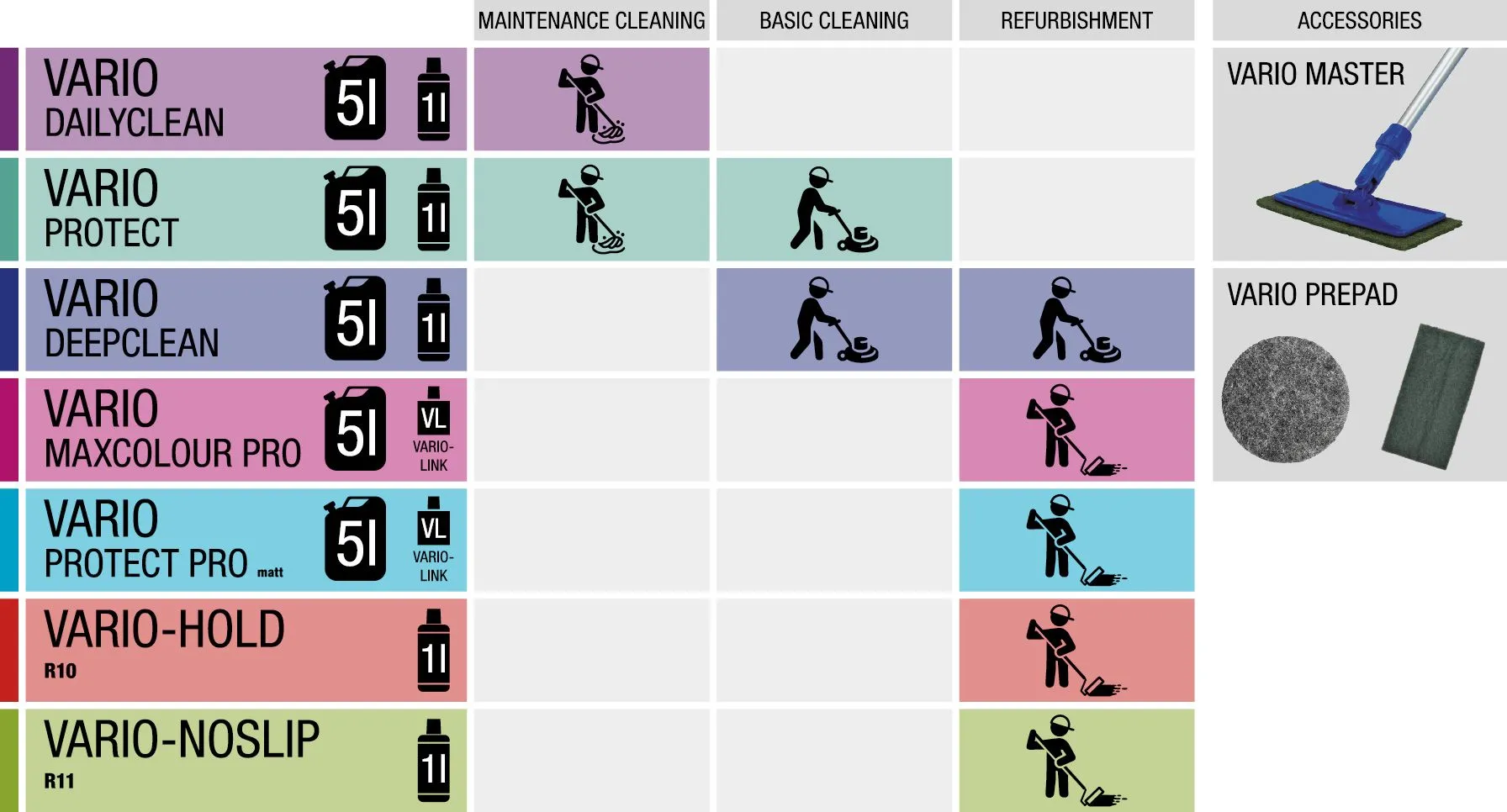
The matrix shows the right product combination for each procedure. The products are available in our online shop. If you have any further requirements, please let us know. We will be happy to advise you individually on the right VARIO-CARE products for your needs.
Slip class: why is it relevant?
Slip classes according to the DIN 51130 test standard are categories that evaluate the slip resistance of floor coverings. This classification is particularly relevant for dance floors, as it affects the safety and performance of dancers. The classification is made in R classes from R9 to R13 or "without slip class". The higher the slip class, the better the slip resistance.
For dance floors, a slip class between R9 and R11 is typically relevant, depending on the specific area of use and the type of dance. On the one hand, a dance floor should offer sufficient grip to enable safe dancing, but on the other hand it should also allow sufficient gliding ability for fluid movements.